João Maria Gusmão
Flatland
Rally all internauts! Sies + Höke Gallery has the pleasure of gracing you with a timely selection of annotated vignettes from the work of João Maria Gusmão—a peripatetic and tragicomic artist of Portuguese origin, born in Lisbon in the year MCMLXXIX. Formed in the waning glow of analog materialism, Gusmão’s practice explores a liminal space where the transcendental, both profane and sacred, collides with concrete realism. His work explores a kind of syncretic estrangement, a conceptual strategy that is at once tautological and relational—entangled with metaphysical inquiries, perceptual riddles, and ontological discomforts. The result is a body of work rich with layered meaning, drawing attention to the limits of understanding, to the strange within the familiar, and questioning the paragons of progress, knowledge and the Western epistemic tradition. Flatland—its title borrowed from Edwin Abbott’s speculative novel—brings together a compelling selection of Gusmão’s most urgent recent works, unearthed from his studio, alongside his latest major project, Animal Farm, previously exhibited at 99CANAL in New York and Galeria Zé dos Bois in Lisbon. Rooted in the long-standing tradition of interrogating and critically reframing the symbolic and material power of 'the vile metal,' this body of work engages in a hermeneutical unpacking of capital’s historical entanglements with violence, production, alienation, and ecological ruin—an ancient yet persistently relevant concern we trust will resonate with contemporary audiences. This presentation is enriched by the insightful audio contributions of Marco Bene and PostBrothers—companions and comrades of the artist—whose deconstructive commentary extends and refracts the work’s inclinations and declinations.


Branca de Neve (Snow White), 2024
Fuji Crystal Archive DPII paper, RA4 Reversal Process Print, 20’×24’ (50.8x61cm) Animal Farm edition for ZDB Edition of 10 + 1 AP unique printsCommentary by Marco Bene

I baked a bun with baking powder flour. Silky, finely milled, and self–raising. Kneaded the dough, stretched and folded, left it to rise until morning. A bread bun mountain to sate real hunger. Built a tall enough stove with bricks and sticks. Filled the furnace with fuel and fumes. Had to climb up a stair to pour in the dough. The devil’s mouth swallowed it whole. It got scorched and burnt, crust to core. No one ate my charcoal bun. Zing!
Rooster at dawn, 2023
16 mm film, vertical projection, color, no sound, 2'33''
Commentary by Marco Bene

Ralph was my favourite rooster. Randy was good rooster, too. Rudolf bit and Riley had bad crow. He savoured soap and got a sore throat. We miss them.

Flat cows make nice yogurt, 2023
16 mm film, anamorphic projection, color, no sound, 8'43''
Commentary by Marco Bene
On the jolly greens of the Alpine county, there once a thrived a race of bovid livestock called Bos Taurus Iogurtum, whose extent in size and fine produce were widely well regarded. Said bulls and heifers fetched high yields at auction houses, for famed they were and made rich whoever owned them. They were like living dairy factories in themselves. I wish I owned such a cow to feed fair family of mine. But I don’t. Only corporations do, and they sure nourish themselves voraciously with fucked up profit.


Bitter orange, 2025
Fuji Crystal Archive DPII glossy paper
RA4 reversal print, 20’×24’ (50.8x61cm) Unique within a series of 10 + 1 AP
My father’s orchard had a single orange tree. He often sat under it. It was a damn ugly tree, crooked trunk and twisted branches. In March, its flowers blossomed. Tea from the buds is said to be soothing. Father’s favorite brew is beer.
Or...
Dutch family Geurts, from Dodewaard, makes good jam, jellies and spreads out of poor man’s fruit. Hell, who could eat them oranges?


Exhibition views from Animal Farm at 99 Canal, New York City. Photos by Kunning Huang
I once heard of a house of many bedrooms. It was the house of our Lord. The doors stood open — warm, welcoming, and inviting. Everyone was free to enter our Lord’s house, sit at His table, eat His bread, and drink from His cup. Our Lord’s house was grand and glorious. Folk would flock in, in awe at the sight of the great celestial retail Palace. They would try the mattresses on the beds, and the toilet seats in the restrooms. They would ask advice from our Lord. They would share their griefs and grievances. But our Lord was always way too busy. People left. Not disappointed, exactly - but with the feeling they might’ve spent more money if there’d been oysters. Lord’s glorious Palace, was His alone. People bargained in other bazaars.
Bedrooms, 2023
16 mm film, color, no sound, 8'10''Commentary by Marco Bene


Window and full Moon, 2025 Fuji Crystal Archive DPII glossy paper, RA4 reversal print 20′×24′′ (50.8x61cm) Unique within a series of 3 + 1 AP

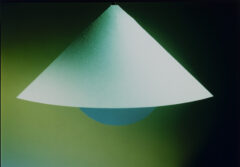
Ceiling lamp off, 2025 Fuji Crystal Archive DPII glossy paper, RA4 reversal print 20′×24′′ (50.8x61cm) Unique within a series of 3 + 1 AP

Pink room, 2025 Fuji Crystal Archive DPII glossy paper, RA4 reversal print 20′×24′′ (50.8x61cm) Unique within a series of 3 + 1 AP

Street lamp and building, 2025 Fuji Crystal Archive DPII glossy paper, RA4 reversal print 20′×24′′ (50.8x61cm) Unique within a series of 3 + 1 AP

Exhibition view from Animal Farm at Galeria Zé dos Bois, photo by Bruno Lopes.
Day for night, 2023
16mm film, colour, no sound, 2'28''There once lived a painter, heir to the impressionist masters, whose canvases were so precisely lit, shadows so sharply cast, that no pigment, paint, or brush was ever required. There once lived a painter, heir to the impressionist masters, whose canvases were so precisely painted with pigment and brush, that no light was needed to see them — for they cast no shadow at all.
Commentary by Post Brothers


Exhibition view from Animal Farm at 99 Canal, New York City. Photos by Kunning Huang.
Mustard piece, 2023
16mm film, colour, no sound, 2'45''The three little piglets went out for a picnic. The sun was shining, and all piggies carried the ease of innocence and high spirit. Little did they know big bad wolf was playing with himself behind a large boulder stone. How unfortunate for them! For right in front of that boulder rock they laid their checkered cloth. The lazy piglet parted a loaf stuffed with snout. The middle one a bap filled with cold-cut gut. And the hog, a pop with chops. The wolf thought twice ‘bout beating his meat. Rolled up his sleeves and licked his teeth. Leapt the rock and gobbled all three cannibal swines and their lunchtime.

Massa Confusa Series
The Grand Arcanum of Massa Confusa compiles the results of a series of photochemical experiments conducted in the laboratory-darkroom of João Maria Gusmão. At the heart of Massa Confusa lies an intimate and alchemical engagement with the artist’s personal collection of Chawan tea bowls—traditional, Japanese-inspired vessels crafted by the British ceramicist Victor Harris (b. 1964, Bristol). For over five centuries, Chawan have played a central role in the Japanese tea ceremony, functioning not only as containers for aromatic infusions but also as symbolic instruments of moral geometry: vehicles for the ritualised contemplation of imperfection, transience, and quietude. Each of Harris’ bowls is handmade, one-of-a-kind, and subjected to the temperamental forces of the kiln—a crucible of unpredictability where clay, glaze, and fire collide in a choreography of chance. It is precisely this dance between intention and accident, this flirtation with the aleatory, that Gusmão channels through his photographic practice. Employing large format cameras and exposing directly onto RA-4 light-sensitive paper, Gusmão manipulates the image within the darkroom, extending the photographic process beyond conventional representation. His experimental method dissolves the boundary between image and object, invoking a tautological echo of Harris’ own method: a procedural transmutation wherein both ceramic and photographic forms become records of entropy, volatility, and transformation. The resulting images, imbued with painterly textures and strangely alien chromatic shifts, evoke a photographic analogue to the ceramic kiln—a volcanic, light-fuelled crucible in which emulsions react, mutate, and solidify into visual artefacts. In these unstable yet meticulous compositions, Gusmão presents photography as both material event and metaphysical enquiry: an art of appearances forged in chemical fire, exploring the logic, illusion, and elemental magic of image-making..
CpXXX, 2022 Fujicolor Crystal Archive RA4 glossy paper, photo reversal chemigram Unique print. 20,3 x 25,4 cm (8x10in) Painted metal frame 70,4 x 55,4 cm
CpgXXX, 2022-24 Chromogenic color print. Reproduction of a photo reversal 8 x 10 inches chemigram in Fujicolor Crystal Archive RA4 glossy paper. Unique print. 125 x 156 cm.
Commentary by Post Brothers


Half a horse, 2023
16 mm film, color, no sound, 2'28''
I used to own half of a modest enterprise. Before that, I owned nothing. Then I partnered, and together we mustered two halves of a toolbox. We struck many nails into fine wood planks and boxes— boxes you could fill parts of your body with: small ones for the head, larger ones for the whole body. It wasn’t science. Our business was contextual. Someone always seemed to need that kind of box. And so, our modesty gave way to a gentle scarcity, with episodes of mild abundance. Owning half of something that feels necessary or urgent is fine—fair, even humbling. But then the mallet stopped. Not all at once. People still needed boxes. We still enjoyed making them. But the handgrips on our tools loosened. The edges dulled. The gears ground, smeared with gravel. And soon, we could no longer hammer through the wood. And so, all in all, I had to muster something else.


NEW EDITION ROTHKO IN A JAR
Introducing, for the true art lover, an authentic art souvenir for the sojourns! Feast your eyes on Rothko in a Jar: a pickled panorama for your perceptual pleasure. A must-have for your culinary corner, your sacred shelf, your kitchen’s kitschiest curiosity cabinet. João Maria Gusmão has conjured not one but twenty of these uncanny conserves for this special gallery edition. Behold your own affordable color field relic — true yet teasingly fake, eternally embalmed in t he artistic brine of analogue photography. Brewed in the artist’s chemical cauldron and darkroom dungeon, this is no mere replica — it’s a photochemical RA4 reversal marvel, an exquisite artifact of instant film photography: bottled brushstrokes on light-sensitive paper, a mummified masterpiecepreserved for the ages. Forget the flimsy knockoffs—a Rothko T-shirt? A Rothko pencil case? Dare to own the paradox. This is the real-ish deal: a shimmering shrine to silence, a devotional jar of distilled contemplation—an art fact truly worthy of the Latvian luminary of lamentation. It murmurs of stillness, spiritual hush, and mystic melancholia—art you can own, hold, and honor. Buy now—or forever forgo this fabulous folly.


This survey was assembled by João Maria Gusmão and Sies + Höke, poetry and prose by the artist, audios by Marco Bene and Post Brothers (post-produced by Bernardo Barata), artworks copyright by the artist and Pato em Pequim, studio views by the artist, exhibition views copyright by the referenced photographers. Thanks to Galeria Zé dos Bois, Lisbon and Natxo Checa; 99CANAL, NY and Baldassarre Ruspoli.